Nihongopedia: a New App for Japanese Learners
Introducing Nihongopedia, Nihonshock’s first iOS app. Nihongopedia is a powerful, expandable study companion for Japanese learners.

Cool Japanese cheat sheet
It’s been four and a half long years since Nihonshock released its original Basic Japanese cheat sheet, and finally I got around to making another freebie!

Advanced Japanese Colors
Like any language, Japanese possesses a myriad of vivid descriptive terms for color. This article will introduce some interesting differences and quirks about color in the Japanese language, and also offer a selection of beautiful Japanese color names so that learners can expand their vocabulary palette beyond simple (and vague) descriptors such as red, green and blue.

Japanese Cheat Sheet Pack Re-release!
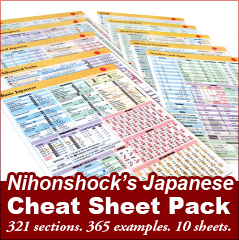
It’s been more than a year since I first released Nihonshock’s Japanese cheat sheet pack, and in that time it became clear to me that I needed to take the product just a little bit further. Therefore, I am re-releasing it…

The Bases of Japanese Verbs
Japanese has very long verb phrases. Things attach to verbs in various ways to produce phrases like 急がなければならない. Just to think, it can be way longer than this. This chain can easily go past six things in succession.
Japanese Onomatopoeia
Onomatopoeia. That’s a big scary term with a much less daunting meaning: any word that mimics a sound. In English, onomatopoeia consists of words like “boom”, “pop”, and “cock-a-doodle-do”.
Of course, Japanese also has onomatopoeia (which they call 擬態語 : ぎたいご). They have LOTS of it…

6 Sites All Japanese Learners Should Bookmark
Today I’m going to share a collection of websites that I think are absolutely amazing resources which everyone learning Japanese should know about. A few of them I don’t use (because I’m already fluent in Japanese), but they’re all sites that I either have used, currently use, or wish I had known about when I was still at the beginner-intermediate level.
36 Cool and Obscure Words (WOTD Roundup)
For the last month or so, (almost) every day, I’ve been posting a #Japanese #WOTD on Twitter. Since information on twitter is quickly buried, I’ll leave a record here for the sake of data permanence…
Reading Practice: the Dead Parrot Sketch in Japanese
Month Python’s dead parrot sketch. It’s deservingly one of the most famous sketches in all comedy, in which John Cleese (Mr. Praline) attempts to return a dead parrot to a stubborn pet shop owner…

Numbers and Time Cheat Sheet (PDF)
For those of you who missed it because you aren’t connected with Nihonshock on either Twitter or Facebook (shame on you!), I just released a digital version of one of the most popular sheets in the full Cheat Sheet Pack!

More from Nihonshock…